A ship Life Cycle Assessment (LCA) is a framework to evaluating different economic and environmental aspects, from its design and building to its end of lifetime. It is a tool to better understand costs, risks, opportunities, trade-offs and nature of environmental impacts.
The basic theory of LCA (Curran, 1996) is transferred to the field of maritime / shipping from the products and services design throughout their lifespan. Especially the economic impact of LCA, has been addressed by the concept of Life Cycle Cost (LCC) (Aurich et. al., 2007; Dhillon, 2013). LCC aims to identify factors that affect cost, to quantify them and to evaluate the cost effectiveness of alternative strategies to incur over a specified period of time. LCA / LCC were applied to energy systems, electromobility, buildings and built environment, food and agriculture, biofuels and biomaterials, chemicals, wastewater treatment, solid waste management, etc. (Hauschild et. al, 2018).
Ships, seen as complex systems, integrated in economic, technical and transportation activities, need to be studied in line with the concept of LCA /LCC (Angelfoss, 1998). Ships’ life cycle is decomposed in three phases:
- the design and ship building (phase I),
- the operation & maintenance (phase II), and
- the end-of-life, demolition and disposal (phase III).
During the ships’ life, designers, shipowners, executives, and others, are confronted with different decision situations that are complex and involve a large number of options and alternatives. For example, in the ship design/construction phase, shipbuilders — based on a primitive ship construction (ship reference) that fulfils all the technical, cruising, safety and environmental regulations — have a large number of options to consider and evaluate as type of fuel and engines, materials for the structure and superstructure, type of generators. Every single combination, if applied to the final ship structure, has economic and environmental consequences.
Fields of application of LCA
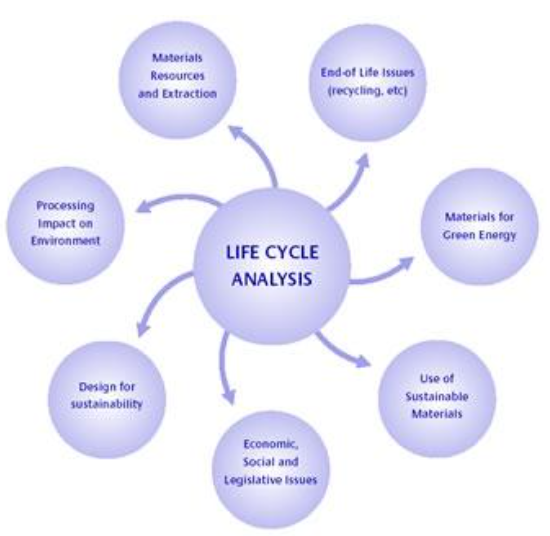
- Materials, resources and extraction refer to the raw materials and energy used for ship building.
- Processing impact on the environment refers to ship building and fabrication of ship components.
- Design for sustainability refers to the important phase of ship design when very important decisions for future energy efficiency are made.
- The use of sustainable materials refers to LCA for comparisons of hull materials and anti-foulings
- Materials for green energy refers to the use and comparison of different fuels
- End of life issues refers to ship recycling and to the Inventory of Hazardous Materials, (IHM)
References
Angelfoss, Alfred, (1998). Life Cycle Evaluations of Ship Transportation, Workshop April 15.-16.,Ålesund College, Report no. 10/B101/R-98/004/00, 1998.
Aurich, J. C., E. Schweitzer, and C. Fuchs 2007. Life cycle management of industrial product-service systems. Advances in life cycle engineering for sustainable manufacturing businesses. Springer London, 171-176.
Curran, M.A. 1996. Environmental life-cycle assessment. The International Journal of Life Cycle Assessment, Volume 1, Issue 3, 1996.
Dhillon, B. 2013. Life cycle costing: techniques, models and applications, Routledge ed.
Hauschild Z. Michael, Ralph K. Rosenbaum, Stig Irving Olsen, 2018. Life Cycle Assessment: Theory and Practice, Springer ed. ISBN 978-3-319-56474-6).
Sharma, P. D. (2006): Life-Cycle Assessment (LCA) –A tool for quantifying Sustainability and sound methodology for describing Environmental Impacts, posted November 2006